The following is a guest post from Dio Favatas, Head of Financial Services Adtech & Identity Strategy at Capgemini. Capgemini is an AI-powered global business and technology transformation partner that delivers end-to-end services and solutions across strategy, technology, design, engineering, and business operations.
Financial institutions (FIs) sit on some of the richest customer data in any industry, including spending patterns, credit behavior, account relationships, life-stage signals. Yet 66% of banks cite insufficient customer insights as a core barrier to effective personalization and conversion, due to fragmented data across product lines and protected-class regulations that create real constraints on how quickly and compliantly it can be put to work.
Here at Capgemini, we talk to FIs every day, and there’s a clear pattern of challenges they face: fragmented data, compliance friction, and mounting pressure from digital-first challengers like neobanks and fintechs. The competitive gap is widening fast.
This is exactly what a composable customer data platform (CDP) is built to solve, and why we’re teaming up with our friends at Hightouch for this blog series to share our insights.
Over the coming posts, we'll explore the architecture decisions, compliance considerations, common use cases, and emerging patterns separating industry-leading FIs from the rest.
But everything starts with the CDP layer, which is what we’ll cover below: why traditional CDPs fall short for financial services, what shifted with the rise of cloud data warehouses, how a composable CDP works, and why it's purpose-built for the unique data complexity FIs face.
Why traditional CDPs fell short for financial services
CDPs emerged around 2015 to solve a real problem: customer data scattered across dozens of systems, with marketing teams lacking a unified view to run effective campaigns. The traditional model worked by copying all your data into the vendor's cloud environment, then giving marketers tools to build audiences and activate campaigns from there.
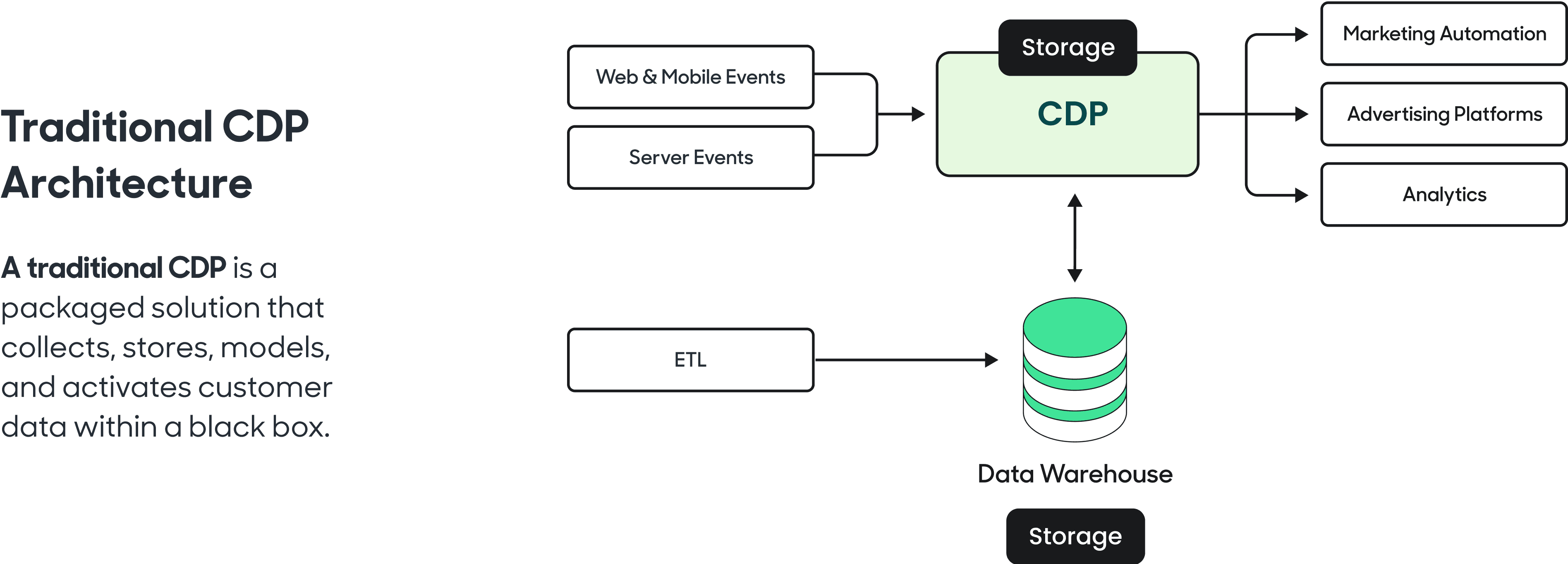
For financial services, this model creates compounding problems:
Data duplication is a compliance liability. Traditional CDPs are built on duplicative storage—your infrastructure and theirs. For regulated industries operating under strict data governance policies and permitted data compliance, duplicating sensitive customer data into a third-party environment is simply not an option.
They only see a sliver of your data. These platforms were built to ingest "user" and "event" data: web clicks, email opens, app sessions. Financial institutions have far richer data—account hierarchies, transaction categorizations, risk scores, loan applications, advisor-client relationships. Traditional CDPs struggle to model this complexity, and integrating it requires expensive custom engineering.
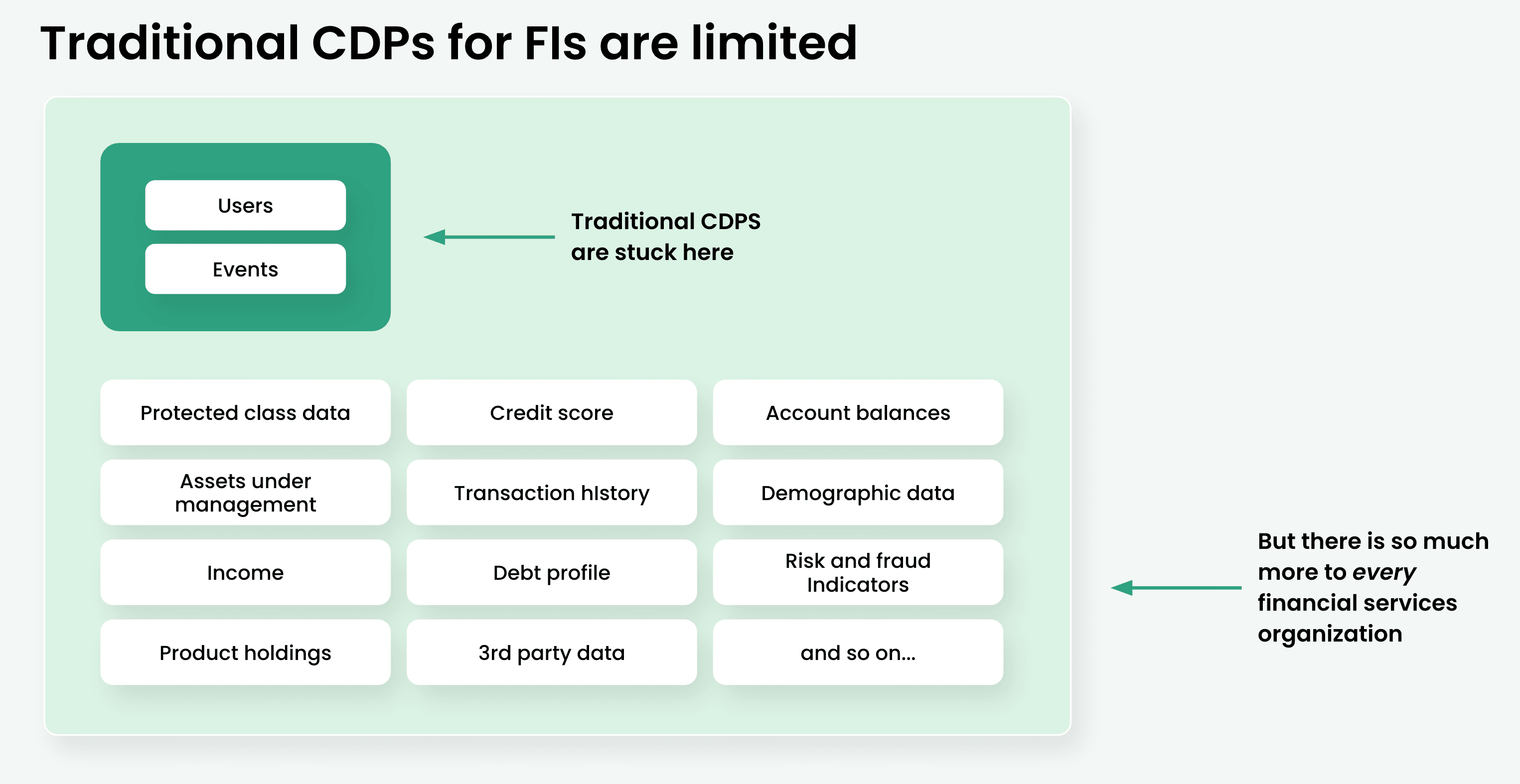
Implementation takes too long and often fails. Traditional CDPs typically require 6–12 months to stand up, and more than 60% of implementations fail to deliver promised value. By the time the platform is live, the marketing strategy may have already changed.
Compliance creates a speed bottleneck. Every new audience segment requires a data request, a compliance review, and a waiting period. Protected-class data restrictions need careful filtering that traditional CDPs provide limited native tooling to enforce. The result: marketing can't move at market speed.
How cloud data warehouses disrupted legacy CDPs
While CDPs were growing, so was something more foundational: cloud data warehouses. Platforms like Snowflake, Databricks, and BigQuery gave data teams a single, governed source of truth for all customer data—not just behavioral events, but everything across every system and division.
Within a few years, the warehouse became the center of gravity for enterprise data. But it created a new tension: marketing's CDP-based view of the customer was increasingly incomplete and misaligned with the richer truth living in the warehouse.
So, what was the data source of truth?
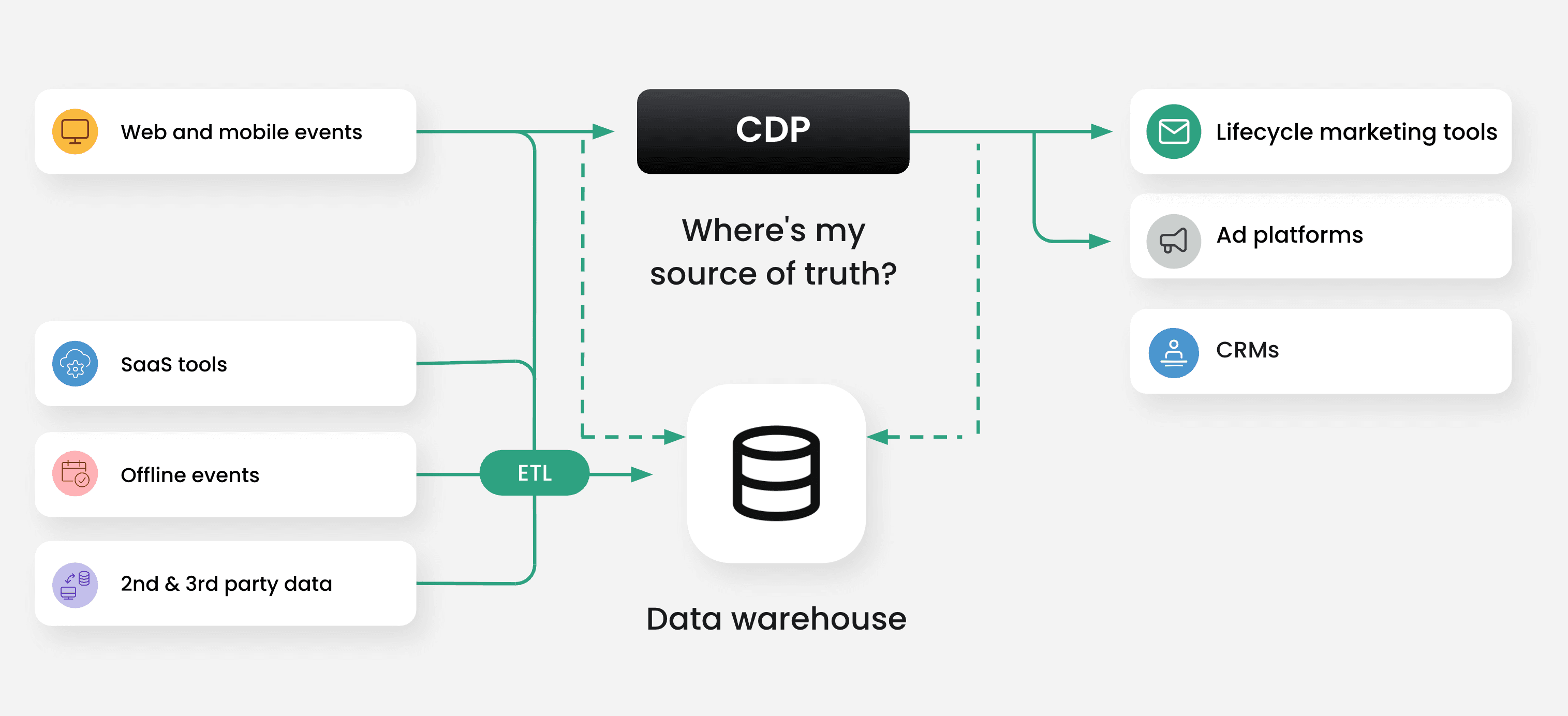
Traditional CDPs were actionable but inaccurate. The warehouse was accurate but inaccessible to marketers.
That gap gave rise to the composable CDP.
What is a composable CDP?
A composable CDP works within your existing data infrastructure rather than alongside it. Instead of copying your data into a vendor's platform, it reads directly from your data warehouse like Snowflake, Databricks, BigQuery, or others, and activates audiences from there to downstream marketing and advertising channels.
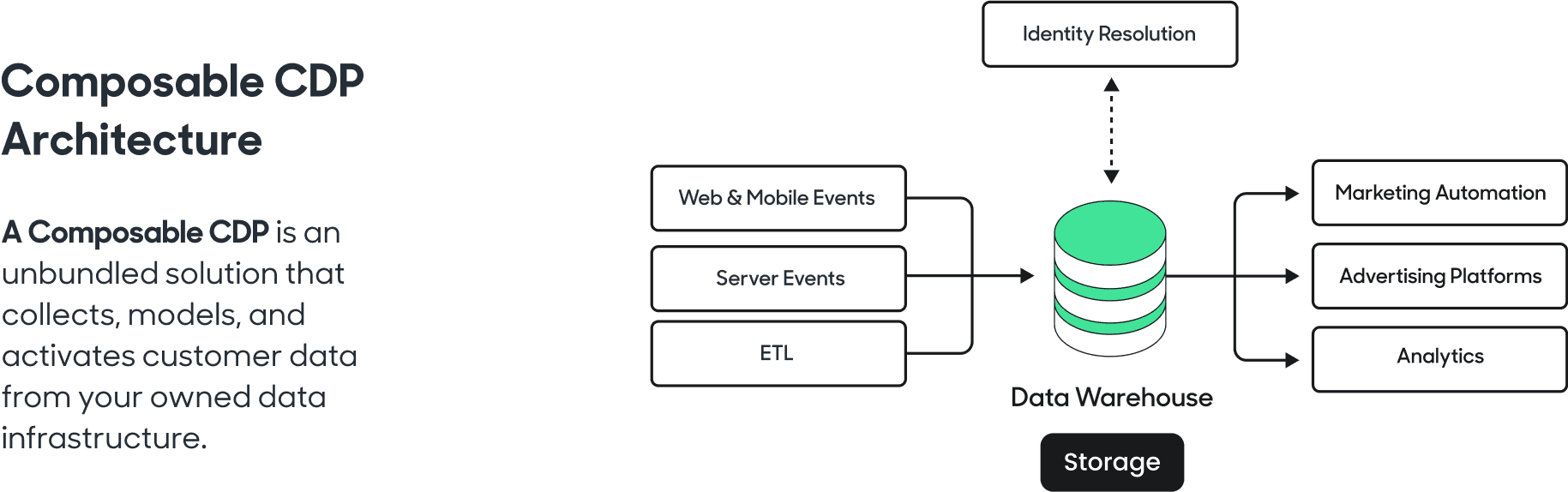
The defining characteristic is zero-copy architecture: your data never leaves your environment. There is no duplicate copy, no secondary data store, no secondary vendor holding your customers' sensitive information.
Four defining traits make a CDP truly composable:
- Warehouse-native: Your data warehouse is the source of truth. The CDP is an activation layer on top of it, not a competing store.
- Schema-agnostic: Works with your data model — account hierarchies, product relationships, household structures — not a rigid vendor schema.
- Modular: Capabilities like audience building, journey orchestration, AI decisioning, and identity resolution can be adopted incrementally and swapped as needs evolve.
- Governed by design: Access controls, consent rules, and compliance filters configured by your data team are inherited automatically—before any marketer touches an audience.
Why composability is ideal for financial services
Composable CDPs, like Hightouch, operate natively within your data warehouse, activating complete customer profiles without ever moving or duplicating data. Every audience build, every campaign, every activation happens where your secure data already lives, keeping you compliant.
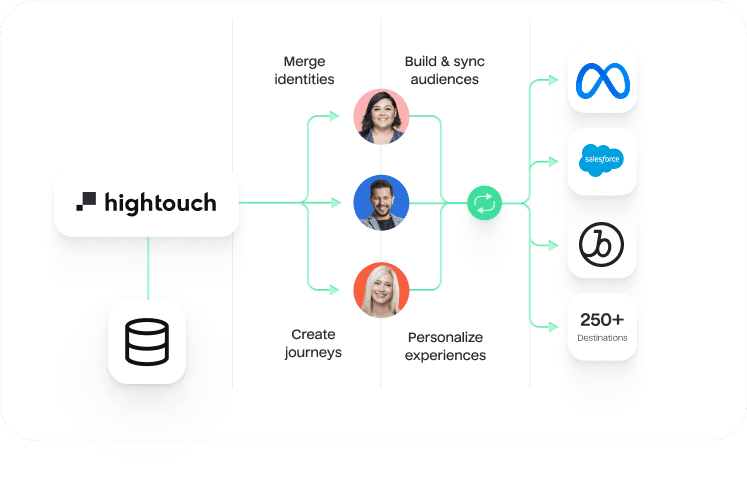
Centering your CDP on your data warehouse creates several critical advantages for financial services organizations specifically.
- Security and compliance without tradeoffs. Because a composable CDP never stores your data, there is no duplicate copy of sensitive customer information in a third-party environment. Your data stays behind your existing security perimeter, subject to your existing certifications. This architectural choice dramatically simplifies your marketing stack's compliance posture.
- Governance and self-service workflows. Protected-class restrictions, consent filters, suppression lists, and role-based access controls can be enforced at the data layer—automatically, before any marketer builds a segment. The result: marketing teams can move autonomously because the guardrails are already built in. Compliance teams get the controls they need. Marketing gets the speed they've always wanted. A win-win scenario.
- Access to your complete data. A composable CDP can leverage any entity, attribute, or relationship in your warehouse: transaction behaviors, product holdings, risk scores, and credit attributes where permitted. This is the difference between surface-level segmentation and genuinely sophisticated real-time personalization using all of your data.
- Native AI and ML activation. Financial services data teams invest heavily in their own proprietary ML models—propensity scores, churn predictions, product recommendations, or lifetime value estimates. In a traditional CDP, those outputs are stranded in the warehouse while the CDP operates on a separate, shallower data set. With a composable CDP, marketers can build audiences directly from propensity scores and trigger campaigns from AI-identified next-best actions, with no additional engineering required.
What to look for when evaluating options
A few things to verify as you evaluate—not all "composable" platforms are built the same way:
- True zero-copy: Does the vendor actually never store your data, or do they maintain secondary data stores?
- Compliance certifications: SOC 2 Type II, HIPAA, ISO 27001, GDPR, CCPA compliance across the full platform.
- Governance depth: Role-based access, protected-class filters, approval workflows, audit logs, destination-level permission controls.
- Schema flexibility: Can it work with your actual data model, including non-user entities like accounts and households?
- Warehouse compatibility: Native, certified integration with your warehouse — Snowflake, Databricks, BigQuery — without custom engineering.
- Time to value: Production use cases in weeks, not quarters.
The reason Hightouch has become an industry leader in composable CDP is that it meets all of these criteria. And it has done so for leading financial services companies ranging from global credit card issuers and digital banks to fintechs and investment platforms because it was designed around these requirements from day one.
Closing thoughts
Financial services companies already have the data to deliver world-class customer experiences. Composable CDPs are what make that data actionable — without creating compliance risk, rebuilding what you already have, or choosing between marketing speed and governance.
The institutions that win the next decade of financial services will be the ones that figure out how to move fast with data while maintaining the trust their customers expect. The architecture to do both already exists.
In our next post, we'll go deeper on why unifying customer profiles directly in your data warehouse, using all of your data is the key to creating true Customer 360 profiles that can power any use case across your business.