Both Hightouch and Amperity are CDPs that allow you to sync data to downstream marketing destinations like CRM tools, email tools, and advertising platforms. Both platforms have the functionality to collect events via an SDK, resolve identities, and sync data to downstream tools.
In practice, Hightouch is a composable CDP and AI platform built for marketers, with real-time activation at its core. Marketers can build audiences, launch campaigns, and personalize experiences using a self-serve interface, while technical teams retain control of the source of truth in the warehouse. This makes Hightouch fast to implement, efficient to maintain, and minimizes ongoing engineering work to keep pipelines running.
Amperity's primary focus is on "identity resolution" solutions. Amperity performs probabilistic identity resolution, which uses AI and machine learning to unify customer profiles. Hightouch's Adaptive Identity Resolution allows users to toggle between deterministic and probabilistic identity graphs.
For marketers, this flexibility matters because identity strategy changes depending on the goal: strict matching for compliance-sensitive workflows, and broader probabilistic reach for acquisition and paid media. Hightouch also pairs identity flexibility with audience building and activation workflows, so teams can go from identity logic to campaign-ready audiences and decisioned personalization in the same platform.
The biggest difference isn’t just where data lives, it’s how quickly marketers can activate it. Hightouch keeps data in your warehouse and focuses on self-serve activation, which reduces implementation time and long-term maintenance compared to platforms that require moving and managing customer data inside the CDP.
The architecture of Amperity and Hightouch are different. Amperity is a “traditional CDP” while Hightouch is a warehouse-centric, “composable CDP”
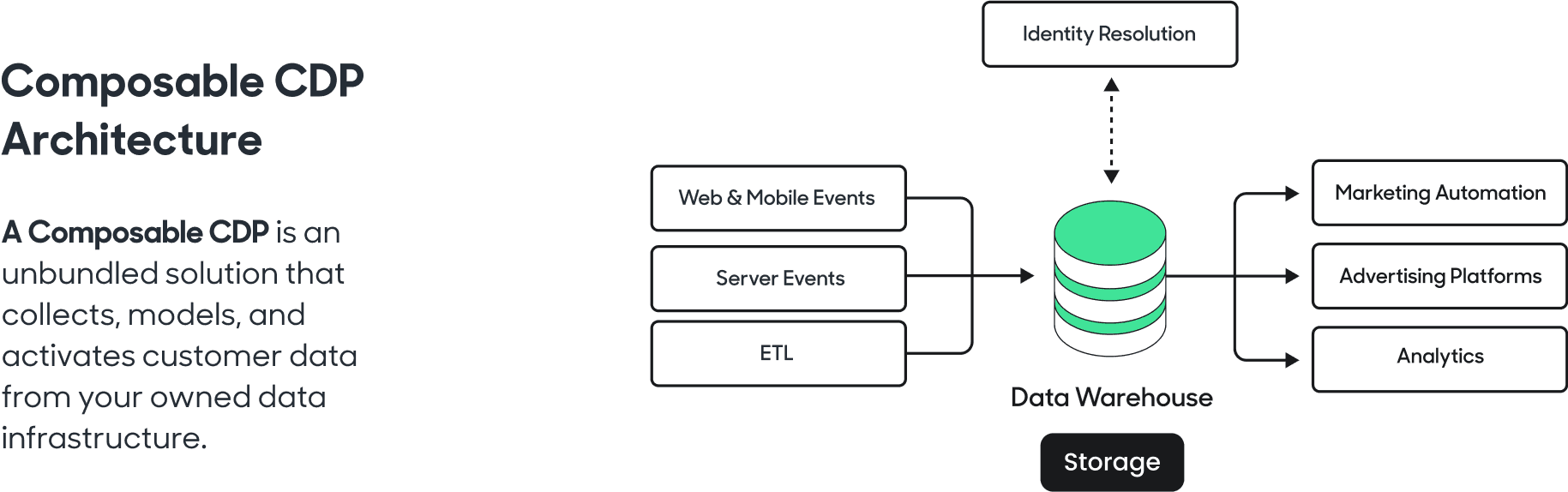
Composable CDP (Hightouch): Data stays in your warehouse, and marketers activate audiences and personalization through self-serve workflows.
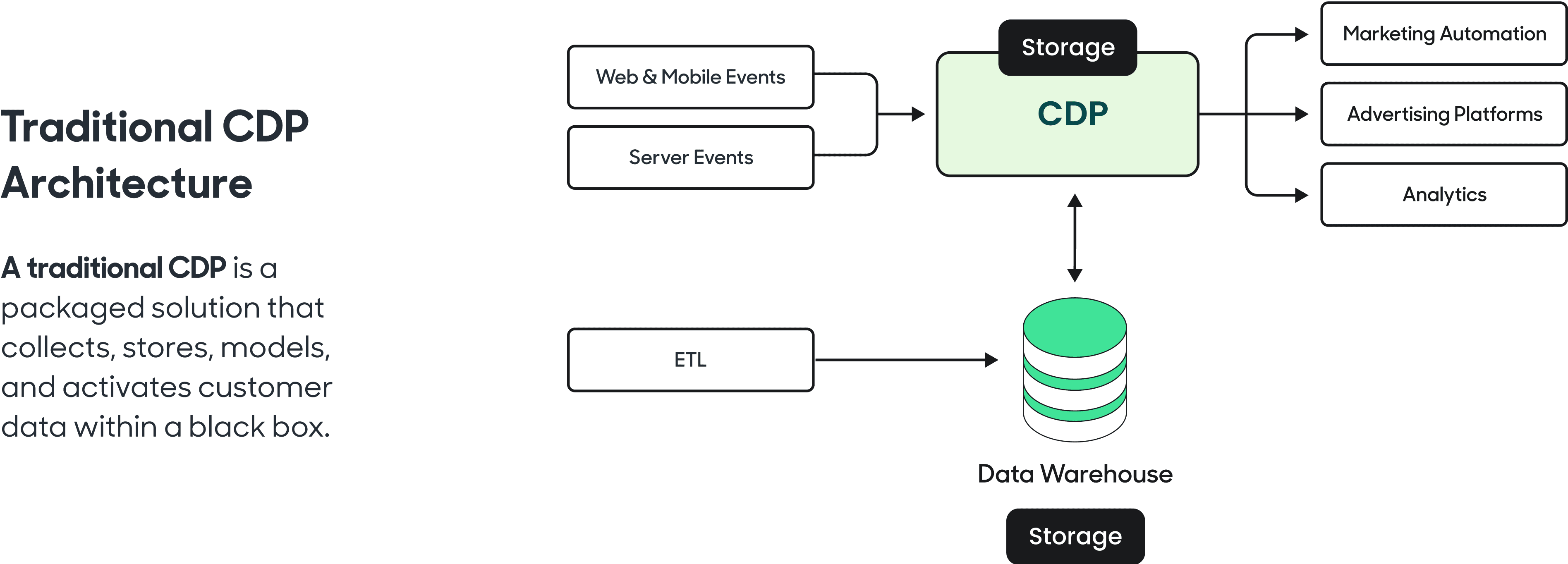
Traditional CDP (Amperity): Data is copied into the CDP’s managed infrastructure before building profiles, audiences, and activations.
This leads to massive differences in cost, implementation time, and usability despite the fact both platforms allow you to do a similar thing at a high-level. Amperity has recently developed a composable integration with just Databricks. Most of their customers still are operating in a traditional, model, however, and Amperity does not yet support composability on any other data warehouse.
Compare Hightouch and Amperity
| Functionality | Hightouch | Amperity |
|---|---|---|
| Data Collection | Client-side, server-side, & other 3rd-party sources | Client-side, server-side, & other 3rd-party sources |
| Data Storage | Your existing data infrastructure (data warehouse, data lake, or database) | Amperity's managed infrastructure |
| Data Retention | Unlimited lookback & history | Variable |
| Data Schema | Controlled by you (supports any custom entity or object) | Controlled by Amperity (opinionated data models centered around user profiles) |
| Audience Management | No-code audience builder (supports any online or offline data stored in your data warehouse) | No-code audience builder (limited to data stored in Amperity) |
| Marketer Self-Serve Experience | Built for marketer self-serve: audiences, activation, decisioning | More implementation-led workflows, less self-serve for marketers |
| No-SQL Audience Building | No-code audience builder powered by warehouse data (no heavy SQL required) | No-code builder limited to data stored in Amperity |
| AI Decisioning / Personalization | AI-driven decisioning for personalized experiences and smarter targeting | Limited decisioning compared to Hightouch focus |
| Experimentation & Measurement | Warehouse-native measurement and experimentation to analyze audiences and campaign impact | Less emphasis on experimentation and measurement workflows |
| Journey Orchestration | Yes | Yes |
| Identity Resolution | No-code tool to define exact or fuzzy-match rules to build owned identity graphs within your data warehouse | Supports both probabilistic & ML algorithms in Amperity's managed infrastructure |
| Identity Graph Storage Location | Lives in your warehouse | Owned by Amperity |
| Reverse ETL | Core sync engine that integrates with existing toolsets & workflows | Limited functionality |
| Real-Time Audience Computation | Dependent upon data landing in the warehouse | Yes (limited to clickstream/behavioral data with no time-based lookbacks) |
| Real-Time Streaming (Event Forwarding) | Yes | Yes |
| Low-Latency Profile API | Yes | Yes |
| Streaming Reverse ETL | Yes | No |
| Data Activation Flow | Warehouse to destination (no data is stored in Hightouch) | Amperity to Destination |
| Activation Destinations | 250+ | 70+ |
| Source of Truth | Single: Your owned data warehouse | Multiple: Amperity & your owned data warehouse |
| Security & Compliance | Data lives in your infrastructure (can be configured to be GDPR, CCPA, & HIPAA compliant) | Data lives outside of your cloud infrastructure (can be configured to be GDPR, CCPA, & HIPAA compliant) |
| Pricing | Unbundled: individually priced features with no MTU billing | Bundled pricing: dependent on monthly tracked users (MTUs) & feature add-ons |
| Proof of Concept (POC) | Less than 1 month | 4-6+ months |
Pros and Cons of Hightouch
Pros
Self-serve, point & click audience builder using any warehouse data (online + offline)
Real-time activation across 250+ destinations for fast campaign launches
AI-driven decisioning for personalization and smarter targeting
Fast to implement and efficient to maintain with minimal ongoing engineering support
Publicly available customer support metrics (99% CSAT Score)
Cons
Must have actionable data available in a data platform (warehouse, lake, or database)
Pros and Cons of Amperity
Pros
Strong identity resolution offerings (probabilistic and ML-based matching)
Non-supported cloud sources can be ingested into Amperity via Fivetran ETL pipelines
Implementation support via solution architects
Cons
More implementation-led workflows, less self-serve for marketers
Long implementation timeline and higher setup complexity
Pricing is based on MTUs and feature add-ons
Limited number of activation destinations compared to Hightouch
Data is stored outside of your cloud infrastructure
Should I Buy Hightouch or Amperity?
When deciding whether to invest in a Hightouch (a Composable CDP) or Amperity (a Traditional CDP), it's important to consider the unique needs of your business. Although a packaged Traditional CDP might appear simpler, Composable CDPs are more flexible and scalable.
The main areas Hightouch wins against Amperity are:
- Marketer self-serve & speed to launch: Hightouch enables marketers to build audiences and activate campaigns quickly, without relying on ongoing engineering support.
- Implementation time: Hightouch can be live fast because it works with your existing warehouse foundation, vs Amperity’s longer implementation cycle.
- Flexibility: Hightouch can activate any modeled warehouse data, not only what’s loaded into the CDP.
- Single source of truth: Your warehouse remains the system of record, reducing duplication and maintenance.
- Adaptive Identity Resolution: Flexible identity strategies per use case.
Hightouch is a composable CDP and AI platform built for marketers, with real-time activation at its core. It’s designed to be easy for both marketers and technical teams, so you can build audiences, sync to destinations, and run personalized campaigns without heavy SQL or ongoing engineering work. And because it’s warehouse-native, it’s enterprise-ready, fast to implement, and efficient to maintain over time.
While Amperity can be a decent option for companies looking to implement a more traditional CDP approach, most data-focused companies are now adopting Composable CDPs, such as Hightouch, because they offer greater flexibility, security, time-to-value, and interoperability at a far lower cost. If you’re interested in learning more about the Composable CDP, book a demo with one of our solution architects today to see how we can help.