LiveRamp has dominated the “data onboarding” market for years, helping brands turn customer data into addressable audiences and measure performance across advertising platforms. But for many companies, that dominance comes at a steep cost, both financially and operationally.
We often hear from marketers who say they “absolutely need” LiveRamp but wish they didn't because it strains the budget, and its dated technology frustrates them.
Publicis’s acquisition of LiveRamp has now raised a new concern: neutrality. For years, LiveRamp sat as neutral infrastructure between brands, agencies, publishers, and ad platforms. Publicis owns it now. Brands that depend on LiveRamp must decide whether they want their identity infrastructure owned by an agency that also serves their competitors.
For brands evaluating alternatives, Hightouch Match Booster is emerging as a modern replacement, quietly displacing LiveRamp by delivering a better, faster experience at a fraction of the cost.
Brands like WeightWatchers, Asana, and TheKey have already made the switch. At WeightWatchers, Hightouch increased match rates across every major ad platform while reducing onboarding costs by 80%.
This article explains how data onboarding works, why teams are leaving LiveRamp, and how Hightouch's warehouse-native design delivers better results with less effort.
How LiveRamp built the data onboarding market
LiveRamp helped define early advertising infrastructure. It generates over $800M in annual revenue and serves as the default onboarding layer for much of the ecosystem.
Its success proved that data onboarding works.
The core idea behind data onboarding is that most brands lack enough identifiers in their first-party data to reach, or “match”, the same users across ad platforms. Sally may use ssmith@yahoo.com on Meta, but sallysmith84@gmail.com when she buys from you. Without a way to link those identities, Meta may not recognize Sally as part of your audience.
Data onboarding solves this problem. It connects customer records to additional identifiers across walled gardens, DSPs, SSPs, CTV platforms, and publishers.
Traditionally, the process looked like this:
- A company exports customer data from internal systems or a warehouse.
- The data is uploaded into LiveRamp.
- LiveRamp matches the records against its identity graph. Each match gets a RampID that represents a real person. Under that RampID sits a bundle of identifiers: hashed emails, phone numbers, device IDs, and cookies.
- LiveRamp uploads those identifiers to ad platforms as audiences and conversion events.
The model works. LiveRamp’s technology improves reach, strengthens suppression lists, boosts retargeting performance, and feeds better signals to ad algorithms.
But the platform also became known for long onboarding cycles, manual workflows, opaque pricing, and aging technology.
The challenges with LiveRamp
Auren Hoffman, LiveRamp's founder and former CEO, recently acknowledged many of the frustrations customers experience with the platform today. He said LiveRamp's onboarding workflows are "way too expensive," "too long," "too bureaucratic," and "too burdensome," and that the product has barely evolved in a decade.
Many marketers, media networks, and technical teams share the same frustration, both privately and publicly. Customers voice their frustration at renewal, causing LiveRamp's customer base to shrink every year since 2023.
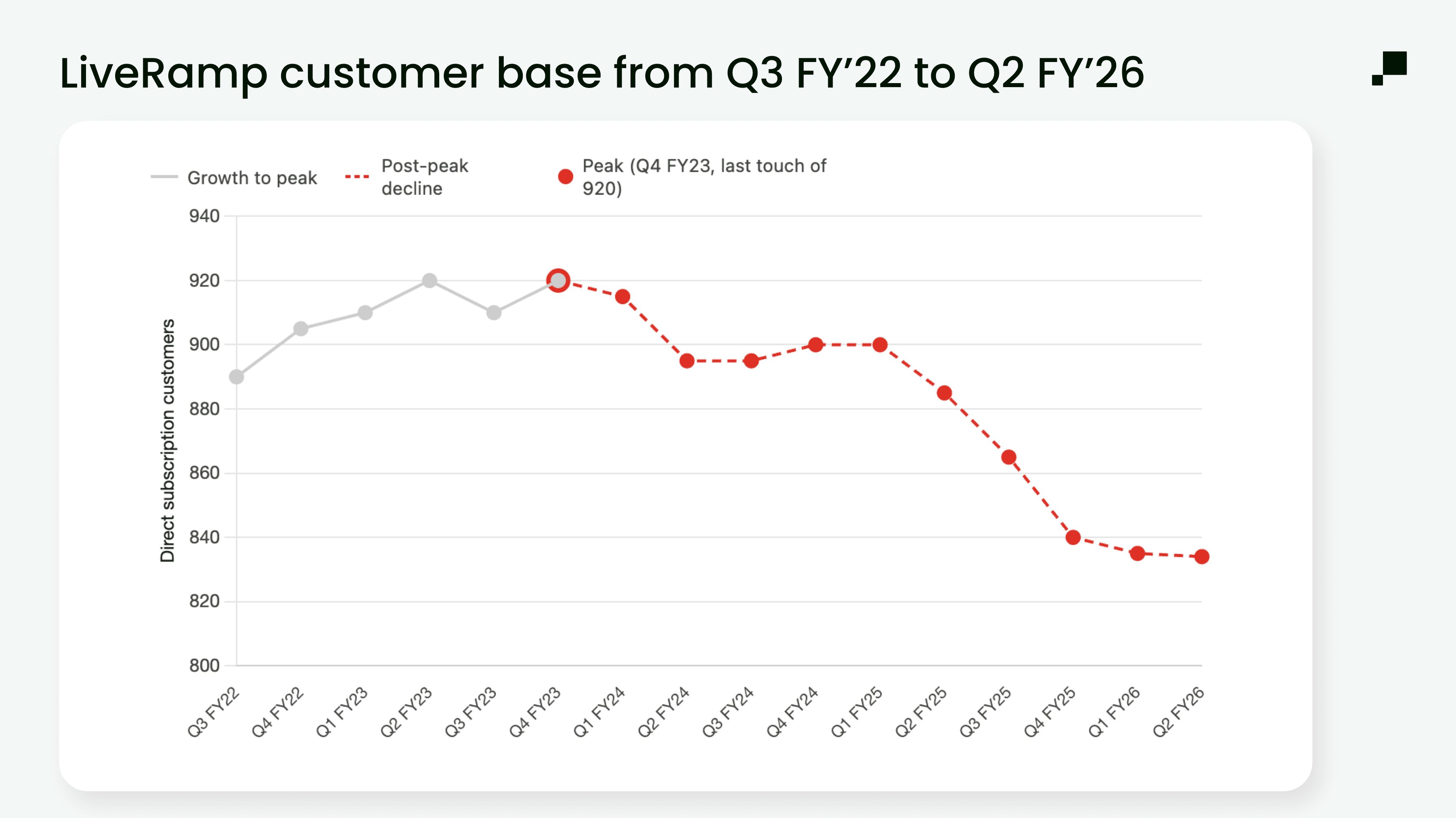
LiveRamp’s customer base has been in decline since 2023.
Six recurring complaints can explain the decline.
1. Data loss reduces match rates: LiveRamp's process depends on matching customer records into its identity graph. Records that fail to match are not passed through to the ad platform. Valuable first-party data is dropped, and match rates suffer.
2. Pricing is expensive and keeps rising: Customers tell us LiveRamp has grown expensive, especially as features like conversion APIs are charged separately from audience activation. Pricing is based on the number of “records under management”, but those records are counted multiple times if the same record is synced across many audiences. Compounding the frustration, customers report annual price increases while the product barely changes.
3. Audiences take weeks to build: Activating a new audience often means exporting CSVs, uploading them through a cloud bucket or network drive, waiting days for processing, and syncing manually across platforms. Work that should take hours takes days or weeks.
4. Marketing has to wait on technical teams: Creating an audience often requires data engineering, marketing operations, and ad operations to coordinate. Marketers depend on engineering to export data, fix formatting, manage jobs, and chase down sync failures.
5. The system is a black box: LiveRamp’s onboarding process is opaque and difficult to configure. Customers cannot choose to target the person or the household level without a support ticket. Visibility into sync issues is limited, so failures persist until ad performance drops and someone notices. And customers cannot see who is added to or removed from audiences, making compliance audits difficult.
6. The tooling feels outdated: Modern marketing teams expect fast, real-time workflows, but LiveRamp's tools feel surprisingly rigid and cumbersome. For example, the Connect audience builder lacks advanced segmentation, and audience statistics can take days to update in the UI.
A better approach to onboarding
The good news is that companies no longer need to rely on traditional data onboarding platforms to boost match rates.
The core idea behind data onboarding has not changed. Adding additional identifiers to customer records still improves match rates across advertising platforms like Meta, Google, TikTok, and The Trade Desk.
What has changed is the infrastructure surrounding it.
Hightouch offers a modern data onboarding solution that enriches and activates audiences directly from the warehouse as data syncs to ad destinations. Match boosting happens in-flight, without storing any data. No CSV exports. No cloud buckets. No multi-day waits.
Marketers build audiences on the full depth of warehouse data and activate them immediately across ad platforms.
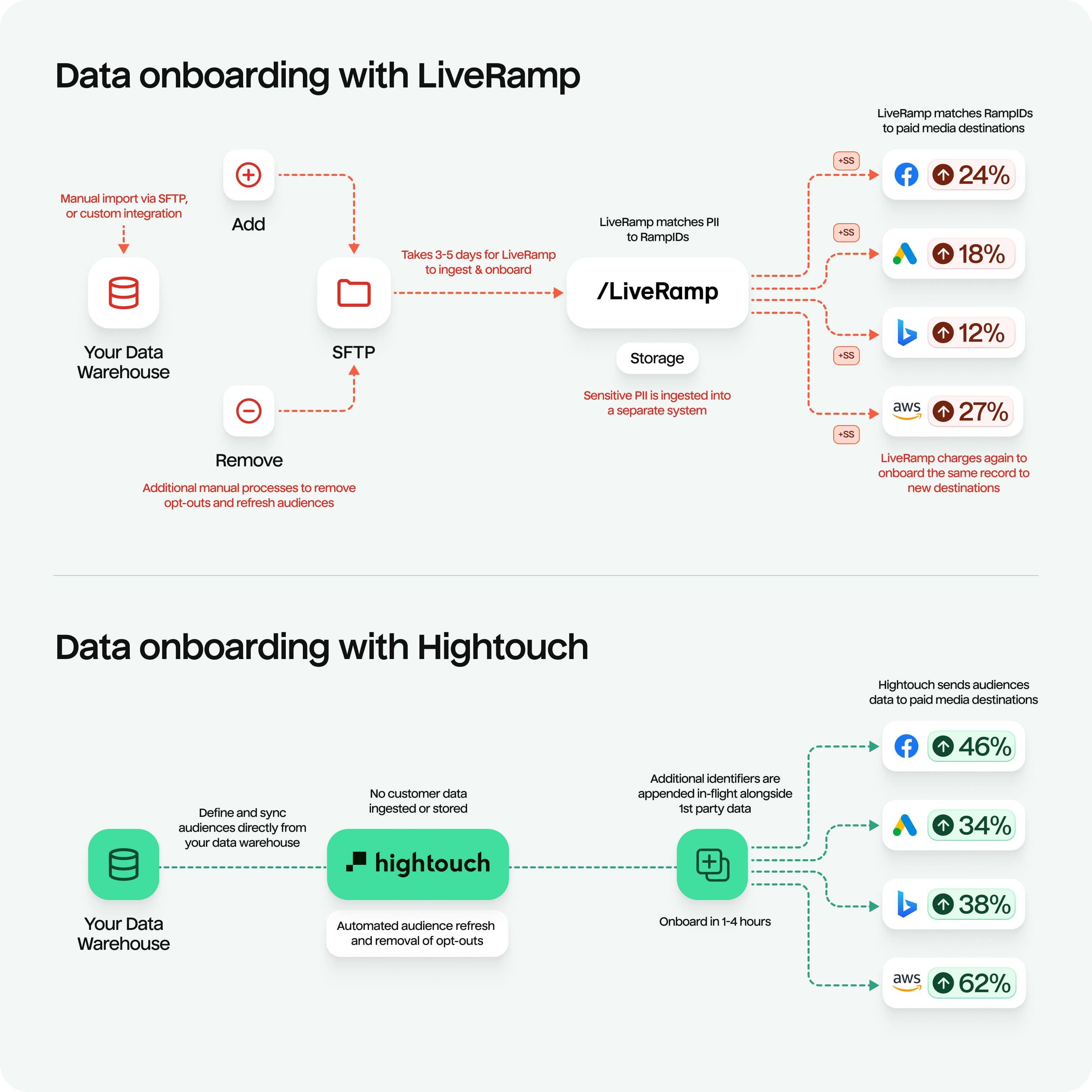
LiveRamp vs Hightouch data onboarding process
That architectural shift has important downstream effects:
- Onboarding happens in hours instead of weeks
- Marketers can operate independently
- Customer data remains within the company’s own infrastructure
- Match boosting becomes observable and configurable instead of opaque
- Onboarding workflows become dramatically cheaper to operate
Match rates often rise, too. After switching from LiveRamp to Hightouch, WeightWatchers saw increases across every major ad platform, including a 155% increase on TikTok.
Why Match Booster outperforms LiveRamp match rates
Perhaps the biggest surprise for companies evaluating Match Booster is that Hightouch consistently outperforms LiveRamp in head-to-head match tests.
Most teams assume that paying LiveRamp's price buys the best match rates. It often does not.
In some evaluations, raw first-party warehouse data outperforms LiveRamp-enhanced audiences, before Match Booster is even turned on.
In one test, a Fortune 500 entertainment company saw direct first-party uploads beat LiveRamp on both Facebook and TikTok. Once Match Booster enrichment was applied, Hightouch beat LiveRamp on Facebook, DV360, Pinterest, TikTok, and Yahoo. On TikTok, Hightouch more than tripled LiveRamp's match rate.
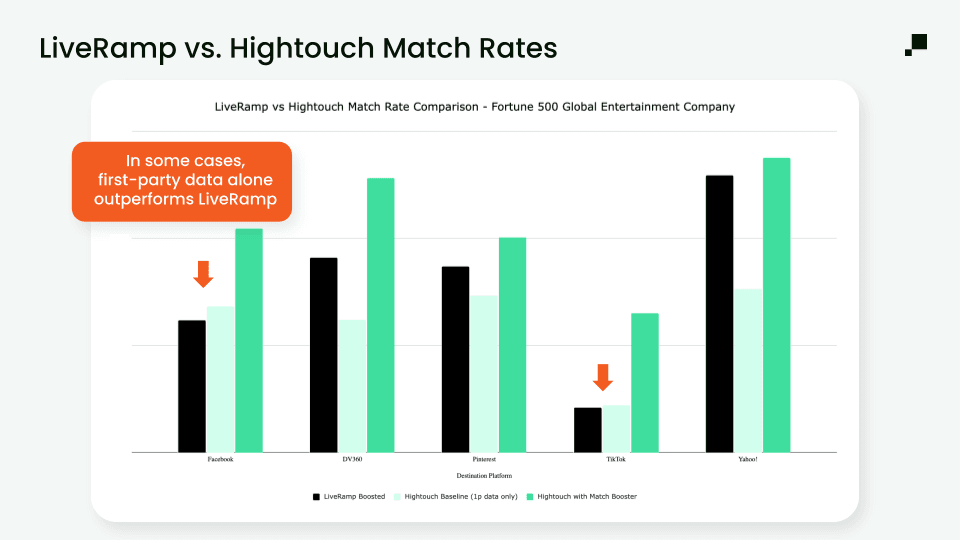
LiveRamp vs Hightouch match rates
Why? LiveRamp's process depends on mapping customer records into its identity graph. If a customer record is not in their graph, the record is dropped and never sent to the ad platform.
That creates a surprisingly common problem: the onboarding process itself results in the loss of first-party data and sub-optimal match rates.
For example, imagine Sally exists in your customer database but cannot be matched to LiveRamp’s identity graph. Even though you have highly valuable first-party identifiers on Sally that could be matched to the ad platform, LiveRamp drops the record and never tries to match it downstream.
Unlike LiveRamp, Match Booster preserves the original first-party data. Hightouch activates data directly and adds third-party identifiers in-flight, rather than dropping records that fail to match an intermediary graph. Rich first-party data plus incremental identifiers usually beats a third-party graph alone.
The future of data onboarding
For years, companies accepted slow, expensive, and painful onboarding because they had no alternative. Now they do.
Companies no longer have to trade operational simplicity for match rate performance. They can have both.
You don’t have to take our word for it. The best way to evaluate onboarding is a head-to-head match test on your own data. Hightouch runs these tests across major ad platforms so teams can measure the effect on match rates, speed, and operational load themselves.
Ready to see the difference? Schedule a meeting to run a match rate test using your own data.